

Every spin of a digital slot reel, every virtual shuffle of a deck, and every roll of an online die is governed by a piece of software that most players never see. That software is the Random Number Generator, or RNG, and it is the engine that drives fairness, unpredictability, and trust in modern casino gaming. Understanding how RNGs work is essential for anyone who wants to know what actually happens behind the interface when they press “play.”
This article breaks down the mechanics of RNGs, the difference between true and pseudo randomness, how these systems are tested, and why they matter for both operators and players.
What Is a Random Number Generator?
A Random Number Generator is an algorithm or hardware device designed to produce a sequence of numbers that lacks any predictable pattern. In casino games, these numbers are mapped to specific outcomes: a symbol on a slot reel, a card in a deck, or a number on a roulette wheel.
Without an RNG, digital casino games would be deterministic. The same input would always produce the same output, which would make the games exploitable and entirely unfair. The RNG ensures that each outcome is independent of the previous one, so the result of the last spin has no mathematical influence on the next.
True Randomness vs. Pseudo-Randomness
Randomness in computing is a nuanced concept. There are two primary categories of RNGs used in gaming systems.
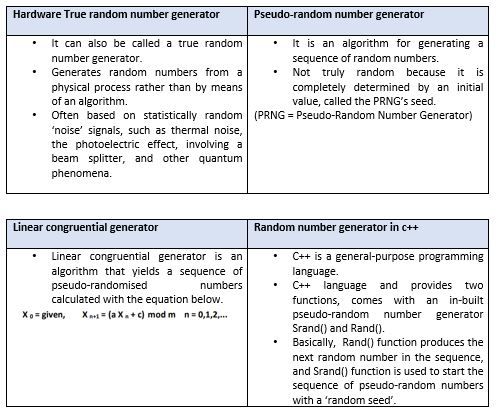
True Random Number Generators (TRNGs)
A True Random Number Generator derives its output from physical phenomena that are inherently unpredictable. Examples include:
- Atmospheric noise
- Radioactive decay
- Photoelectric effects
- Thermal or quantum fluctuations
Because these sources are physical and non-deterministic, TRNGs produce genuinely random output. However, they are slower and more expensive to implement, which limits their use in high-volume casino environments.
Pseudo-Random Number Generators (PRNGs)
Most online casino games rely on Pseudo-Random Number Generators. A PRNG uses a mathematical formula and an initial value called a seed to generate a sequence of numbers that appears random. If the seed is known, the entire sequence can be reproduced, which is why the security of the seed is critical.
The key distinction is that PRNG output is deterministic in theory but statistically indistinguishable from true randomness when designed and seeded correctly. This is what makes PRNGs suitable for casino gaming: they are fast, scalable, and capable of producing millions of outcomes per second across thousands of concurrent players.
How Seeds and Algorithms Work
The seed is the starting point of any PRNG sequence. In casino systems, seeds are typically generated from high-resolution system clocks, user input timing, or hardware entropy sources. Once seeded, the algorithm applies a series of mathematical operations, such as linear congruential methods or the Mersenne Twister, to produce outputs.
Every game cycle pulls the next number from this sequence and translates it into a game result. Because the mapping between the number and the outcome is fixed by the game’s paytable and reel configuration, the RNG ultimately determines the probability distribution of every possible result.
The Role of RNGs in Different Casino Games
RNGs function differently depending on the type of game.
| Slots | Generates reel stop positions | Each number maps to a symbol combination |
| Video Poker | Shuffles and deals cards | Numbers correspond to a deck index |
| Roulette | Selects winning number | Number maps to a pocket on the wheel |
| Blackjack | Shuffles the shoe | Sequential card draws from shuffled deck |
| Crash Games | Determines crash point | Number maps to a multiplier ceiling |
In each case, the RNG does not “decide” whether a player wins or loses. It simply produces a number, and the game’s rules interpret that number. This distinction matters because it clarifies that RNGs are neutral mechanisms, not adversarial systems.
Testing and Certification of RNGs
Regulated jurisdictions require RNGs to be independently tested and certified before they can be used in live casino products. Testing typically involves:
Certification bodies such as eCOGRA, GLI, and BMM issue compliance reports that operators must publish or make available to regulators. These audits are repeated periodically and after any significant software update.
Why RNGs Matter to Players
For players, the RNG is the foundation of fair play. It guarantees that:
- Each outcome is independent of past results
- No pattern exists that can be exploited
- The game’s advertised RTP is mathematically valid over time
- Operators cannot manually alter outcomes in real time
This is why the concept of “due for a win” is a misconception. A slot machine does not track how long it has been since its last payout. Every spin is generated from the same RNG process, and the probability of any given outcome remains constant.
The Limits of RNG-Based Fairness
RNGs guarantee statistical fairness, but they do not guarantee that any individual player will profit. The house edge is built into the paytable and probability distribution, not into the RNG itself. Over millions of spins, the operator’s margin emerges naturally from the math.
It is also worth noting that RNGs govern only the randomness of outcomes. They do not control game speed, betting limits, or promotional mechanics, all of which can influence a player’s experience and bankroll.
Conclusion
Random Number Generators are the unseen architecture of digital casino gaming. Whether implemented as true hardware-based systems or pseudo-random algorithms, they ensure that every outcome is unpredictable, independent, and statistically sound. Certification and continuous testing keep these systems honest, and a basic understanding of how they work helps players separate legitimate randomness from superstition. The next time a reel stops on a winning combination, the credit belongs not to luck alone, but to a carefully engineered sequence of numbers.